The Truth About AI Transcription: Does 99% Accuracy Actually Exist?
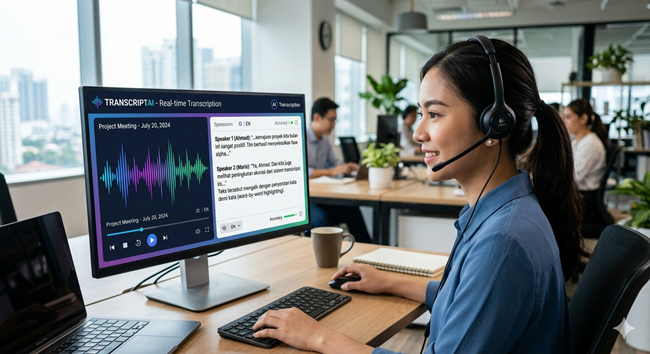
We’ve all seen the bold claims plastered across landing pages: “Up to 99% transcription accuracy.” But if you’ve ever actually had to rely on automatic captions, you have every right to be a little skeptical. Chances are, you’ve spent frustrating hours correcting messy transcripts full of bizarre punctuation errors, fixing names that the AI completely butchered, or constantly rewinding a recording just to double-check a specific quote.
When you’re relying on transcripts for important meeting notes or content creation, manual transcription is just too slow, and bad automated transcription is far too risky. So, it begs the question: Can audio transcription actually hit that magical 99% accuracy mark in real life?
Let’s break it down honestly, looking at the technical realities and how it actually performs in everyday situations.
What Does “99% Accuracy” Actually Mean?
Before we put the claim to the test, we have to understand how accuracy is even measured in the first place. Most AI transcription systems use an industry standard called Word Error Rate (WER).
WER calculates three specific types of mistakes:
- Substitutions: The AI used the wrong word.
- Insertions: The AI added an extra word that wasn’t spoken.
- Deletions: The AI completely missed a word.
When a company claims a 1% error rate (meaning 99% accuracy), they are saying there will be roughly one mistake for every 100 words spoken. So, in a standard 1,000-word transcript, you should expect to see about 10 small errors.
The key takeaway here is that 99% accuracy does not mean zero mistakes. It means the errors are usually minor, very easy to spot and correct, and rarely alter the overall meaning of your text. But how realistic is that in practice?
How Modern Transcription Actually Works
Early transcription tools were incredibly frustrating because they relied on basic acoustic matching—they simply tried to match a sound to a word. Modern systems are a completely different beast.
Today’s advanced speech-to-text engines rely on deep neural networks, context-aware prediction models, massive multilingual datasets, and sophisticated noise suppression algorithms. For example, platforms like Vomo.ai utilize cutting-edge ASR (Automatic Speech Recognition) models, including Azure Whisper, OpenAI Whisper, and the highly powerful Nova-2 engine.
Why the Engine Matters
Nova-2 is a game-changer because it pushes accuracy up to that 99% mark under optimal conditions. It doesn’t just “listen” to sounds; it uses context modeling to predict words based on the meaning of the sentence. It can infer where punctuation should go, adapt to various accents, handle niche domain vocabulary, and actively filter out background noise. Transcription quality today is dramatically better because it’s about understanding context, not just hearing syllables.
Putting It to the Test: Real-World Scenarios
Theory is great, but practical application is what matters. Here is how that 99% claim actually holds up across different real-world environments.
1. The Quiet Professional Environment (Near 99%)
If you have a single speaker using a good microphone in a quiet room with clear pronunciation, 99% accuracy is entirely realistic. Under these conditions, engines like Nova-2 perform beautifully. You’ll get an extremely clean transcript with nearly zero word substitutions and only minor punctuation edits required.
2. The Classroom or Lecture Hall (97–99%)
What happens when you introduce mild echo, mixed accents, and occasional background movement? The accuracy dips slightly, but remains incredibly high. You might see a few more filler words captured or a rare misheard proper noun, but the output remains highly readable. For students converting lectures into text, the clean-up time is minimal, and the core meaning remains fully intact.
3. Remote Meetings and Sales Calls (95–99%)
Remote calls introduce varying microphone qualities, light background noise, and overlapping speakers. In this scenario, the AI might occasionally struggle with overlap detection, requiring some minor corrections. However, it’s still miles ahead of older auto-captioning tools, preserving the flow and meaning of the conversation effortlessly.
4. On-the-Go Mobile Voice Memos
Many creators rely on their phones to capture ideas on the fly. When transcribing voice memos, your microphone quality is the biggest variable. A quiet room will yield near-perfect results, while an outdoor recording will introduce some noise-related edits. At this stage, the physics of your microphone matters just as much as the AI model.
How You Can Maximize Your Accuracy
You definitely don’t need a professional recording studio to get great results, but a few simple habits can drastically improve your output:
- Ensure a stable internet connection for remote calls.
- Try to avoid talking over one another.
- Speak clearly at a normal pace (there’s no need to sound robotic).
- Minimize heavy background noise like fans or traffic.
- Use a dedicated microphone or a good headset whenever possible.
AI is incredibly powerful, but feeding it clear audio makes its job significantly easier.
Beyond Accuracy: Why Structure is the Real Prize
Here is a secret that most people miss: to the average user, reading a transcript with 98% accuracy feels almost identical to reading one with 99% accuracy. Once the text is easily readable, the minor differences fade away.
The real productivity magic happens after the transcription is finished. This is where static text transforms into a powerful knowledge asset. Nobody actually wants to scroll through pages of raw text, searching manually for a specific idea.
This is exactly where Vomo.ai shines. Instead of just giving you a transcript, Vomo’s Ask AI—which is now powered by the incredibly advanced GPT-5.2 model—turns that raw text into something actionable. It acts as an intelligent meeting note-taker, instantly generating structured outlines, concise summaries, action items, and highlighted quotes.
Accuracy captures the language, but the AI captures the actual insights.
From Basic Transcription to Knowledge Management
If you just convert audio to text, you’ve saved yourself some typing. But when you pair accurate transcription with advanced AI summarization, you gain serious leverage. You can extract key takeaways instantly, generate formatted meeting minutes, build a searchable archive of your calls, and turn rough interviews into polished content drafts. Your recordings evolve from dead files sitting on a hard drive into a dynamic, searchable database.
Step-by-Step: Test the Accuracy Yourself
If you’re still on the fence, the best thing to do is test it yourself. Whether you decide to try an audio to text free online tool for a quick baseline, or jump straight into a premium platform like Vomo to see top-tier Nova-2 processing in action, the process is incredibly straightforward.
- Record Controlled Audio: Pick a short 2-minute script and record it clearly in a quiet space.
- Generate the Transcript: Upload the file and let the ASR engine process it.
- Compare and Grade: Look at the generated text alongside your original script. Count the word substitutions, missed words, and punctuation errors to estimate your own Word Error Rate.
- Push the Limits: Once you have a baseline, try a harder test. Add some background noise or record a natural conversation to see how the platform handles real-world chaos.
The Bottom Line
Let’s be completely transparent: AI accuracy is fantastic, but it isn’t magic. Heavy background music, rapid cross-talk, and poor microphones will always cause error rates to rise. Human transcription still holds value for highly complex legal or medical recordings, but it’s expensive and slow.
For professionals, creators, and students, modern AI transcription delivers an unbeatable speed-to-accuracy ratio. Thanks to advancements in language modeling, context-predictive decoding, and noise suppression, hitting that 99% accuracy mark is genuinely realistic under controlled conditions.
But ultimately, accuracy is just the baseline. What matters more is having clean readability, incredibly fast turnaround times, and the AI tools to turn those spoken words into actionable insights.[]